
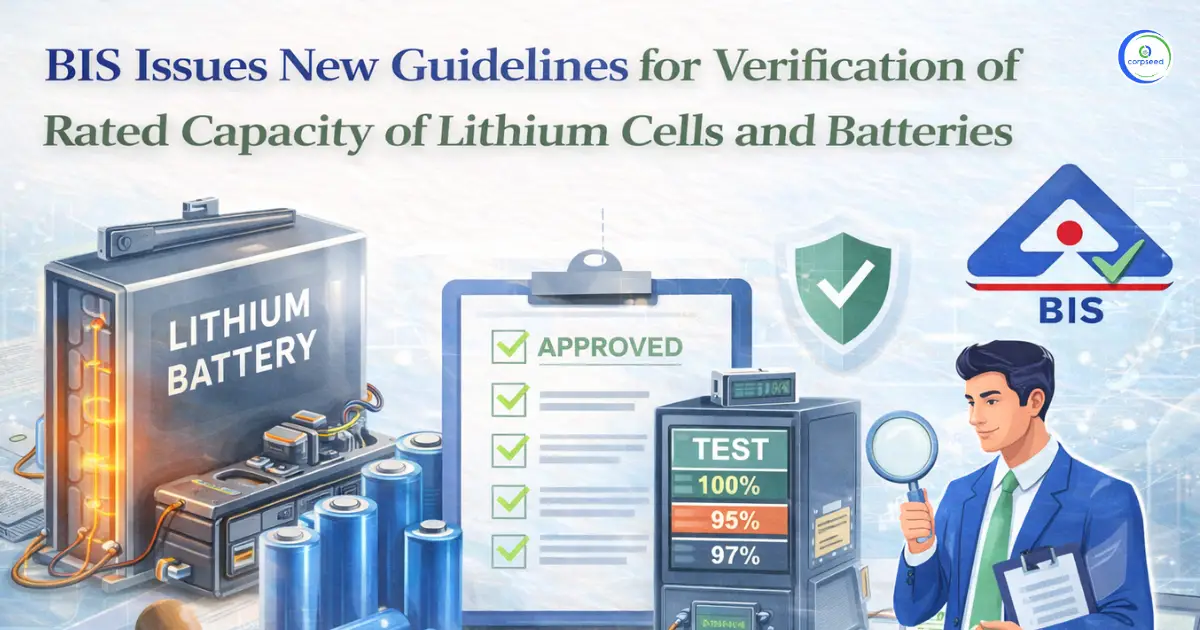
The Ministry of Electronics and Information Technology (MeitY) has instructed the Bureau of Indian Standards (BIS) to enhance the verification system for the rated capacity of lithium-ion cells and batteries registered under the Compulsory Registration Scheme (CRS). BIS has now provided updated guidelines with regard to the safety requirements of secondary lithium cells and batteries in compliance with the requirements of IS 16046 (Part 2):2018, which governs the safety requirements of secondary lithium cells and batteries. This regulatory clarification has a direct effect on manufacturers, importers, and brand owners seeking or maintaining BIS registration for lithium-ion batteries in India.
Table of Contents
- Why This BIS Order on Rated Capacity Was Issued
- The New Testing Requirements for Rated Capacity Verification
- Implementation Guidelines for Existing Licensees
- Mandatory Actions for Existing Licensees
- Guidelines for New Applicants Applying for BIS Registration of Lithium-Ion Batteries
- What New Applicants Must Do
- Impact on Manufacturers and Importers
- What Happens If You Don’t Comply?
- Conclusion
The aim is to make sure that the declared battery capacity demonstrates actual discharge performance in standardized test conditions, eliminating misleading claims, and reinforcing compliance under the national certification framework.
Why This BIS Order on Rated Capacity Was Issued
Ever since lithium-ion batteries became conventional in consumer electronics and high-growth markets such as electric mobility and solar storage, regulators noticed a trend: most batteries in the market were labelled with high capacities that did not correspond to the real-world performance.
These discrepancies created several problems:
- Consumers paid for more capacity than they received.
- Electric cars and power storage systems provided lower run times than promised.
- Low-quality products with exaggerated specifications flooded the market.
- Compliance documentation often didn’t match independent laboratory results.
In response, the Ministry of Electronics and Information Technology (MeitY) issued an order dated 3 February 2026 that required rated capacity to be measured and reported in compliance with Clause 7.3.1 of IS 16047 (Part 3):2018, which requires performance claims to be consistent with standardised testing. BIS was then directed to implement this in the BIS CRS (Compulsory Registration Scheme) to ensure that certificates issued under standards such as IS 16046 (Part 2):2018 show both safety and capacity performance
This order safeguards consumers, provides fair competition, and aligns Indian lithium battery regulations with international standards.
The New Testing Requirements for Rated Capacity Verification
As per the new rules, lithium-ion batteries and portable sealed secondary cells have to pass a well-defined test before they can qualify for BIS certification.
- Mandatory Capacity Measurement Test: All lithium-ion batteries should be subjected to a rated capacity test in a BIS-approved laboratory. In this test, the batteries are fully charged and discharged at a given current and temperature, usually at 20°C, to determine the actual energy output as compared to the declared capacity.
The test method referenced is:
- Clause 7.3.1 of IS 16047 (Part 3): 2018 (Standard test for discharge performance and rated capacity measurement).
This ensures all test results are consistent, repeatable, and verifiable within a single reporting format.
- Unified Test Report Format: BIS has required the adoption of a new Unified Test Report Format (UTRF) in which the test conditions and measured capacity are clearly documented. This implies that the laboratories providing test reports should clearly indicate the results of capacity tests in the official TRF that is attached to each BIS registration application.
- Reporting and Documentation: Manufacturers must generate test requests through BIS’s Laboratory Information Management System (LIMS) and include test results with their CRS application or renewal request. Test reports should cover:
- Measured discharge capacity
- Declared rated capacity
- Test conditions
- Compliance verdict
Without this detailed information, BIS will not accept the application for certification.
- Alignment with Safety Standards: The new capacity testing does not replace safety tests under IS 16046 (Part 2):2018 / IEC 62133-2:2017. Rather, it supplements them by adding performance verification to the regulatory framework already focused on safety.
This dual requirement ensures batteries are both safe and truthful in performance claims.
--------------Blog Contact Form-------------
Implementation Guidelines for Existing Licensees
If your company already holds BIS registration for lithium cells or batteries, these changes affect how you maintain your license.
- Compliance Deadlines: BIS has established phased timelines based on your current license validity:
- For licenses valid until 30 April 2027: you must complete capacity verification tests and submit documentation by that date.
- For licenses valid beyond 30 April 2027: you must comply before your license expires.
This gives manufacturers time to coordinate testing without disrupting ongoing operations.
Mandatory Actions for Existing Licensees
All existing registrants must take the following steps:
- Engage a BIS-recognized third-party laboratory for rated capacity testing.
- Create the test request using LIMS to achieve traceability.
- Provide test reports and compliance undertakings on all models within your scope.
- Update your online profile and CRS application with verified capacity records.
BIS might need an undertaking that confirms compliance for series or related models that have not been individually tested yet.
These are requirements that must be met, and failure to do so may result in severe repercussions such as suspension or cancellation of your BIS registration.
Guidelines for New Applicants Applying for BIS Registration of Lithium-Ion Batteries
For manufacturers and importers seeking new BIS registration under the Compulsory Registration Scheme (CRS) for lithium-ion cells and batteries, rated capacity verification is now a mandatory part of the certification process. The approval is no longer limited to safety compliance under IS 16046 (Part 2):2018. Before BIS certification is given, applicants have to prove that the stated rated capacity of their lithium-ion battery has been properly tested and confirmed in line with the relevant Indian Standard.
What New Applicants Must Do
- Submission of product sample to safety testing and rated capacity testing should be done jointly in a BIS-recognized laboratory. Applications without capacity verification will be considered incomplete.
- Ensure that the laboratory test reports are included in the rated capacity results in the revised Unified Test Report Format (UTRF), and that the measured discharge capacity under prescribed test conditions is clearly indicated.
- Present detailed and complete technical documentation, such as stated capacity, product specifications, discharge parameters, and labeling information that is consistent with the laboratory results.
Impact on Manufacturers and Importers
The revised BIS regulations on rated capacity verification have a great impact on the development, testing, and marketing of lithium-ion batteries in India. The compliance is no longer limited to safety testing under IS 16046 (Part 2):2018 and must be properly validated in terms of performance before or during BIS registration.
- Greater Technical Accountability: Manufacturers should make sure that the stated battery capacity is equal to real discharge performance under prescribed test conditions. In India, products cannot be sold unless capacity claims are backed by verified laboratory results.
- Stronger Role of BIS-Recognized Laboratories: The independent third-party labs play a key role in the validation of rated capacity. Self-declared specifications that are not properly tested will not comply.
- Enhanced Digital Compliance: BIS systems like LIMS are mandatory and enhance transparency and traceability in testing and certification documentation.
- Fairer Market Competition: Stricter verification dismisses exaggerated capacity claims, profiting those manufacturers that comply and enhance consumer confidence in BIS-certified lithium-ion batteries.
What Happens If You Don’t Comply?
All lithium-ion batteries registered under the BIS are required to comply with the new BIS-rated capacity verification guidelines.
In case of noncompliance by a manufacturer or importer, BIS may:
- Suspend the BIS registration.
- Cancel the registration
- Eliminate certain models off the approved scope.
- Reject new or renewal applications.
Non-compliant products identified during market surveillance that fail to meet declared capacity may also face enforcement action.
Conclusion
The new guidelines by the Bureau of Indian Standards for the verification of rated capacity of lithium-ion cells and batteries is a major change in the compliance environment in India. The regulator has enhanced transparency and accountability in the battery industry by incorporating performance validation with safety requirements as stipulated in the IS 16046 (Part 2):2018 and the BIS registration framework. Manufacturers and importers are now required to make sure that they are supported by standardized laboratory testing. The reform will encourage healthy competition, guard consumers against false assertions, and boost confidence in BIS-certified lithium-ion batteries in the fast-growing energy and electronics markets in India.
This portion of the site is for informational purposes only. The content is not legal advice. The statements and opinions are the expression of author, not corpseed, and have not been evaluated by corpseed for accuracy, completeness, or changes in the law.
BOOK A FREE CONSULTATION
Get help from an experienced legal adviser. Schedule your consultation at a time that works for you and it's absolutely FREE.


_Amendment_Order_2026_New_Compliance_Rules_Corpseed.webp)


.webp)